
For years, "cardio" has had a branding problem. If you walk into most commercial gyms, you see rows of people on treadmills trying to "burn off" their lunch. It is viewed as a transaction: I ate X calories, so I must do Y minutes of cardio to cancel it out.
This view misses the point entirely.
Aerobic training is not about calorie management. It is about building the efficiency and capacity of your body's engine.
This engine, your Cardiorespiratory Fitness (CRF) is not just about how fast you can run a mile. It is a measurement of how well your respiratory system, heart, vascular system, and mitochondria work in unison to turn oxygen into life.
Recent data has fundamentally shifted our understanding of health risk. While we rightly worry about cholesterol and blood pressure, it turns out that your aerobic fitness is a more potent predictor of how long you will live than almost any other biomarker we can measure.
In this deep dive, we will break down this first Component of Fitness. We will explore the "Fitness Triangle," why "Zone 2" is the foundation of cellular health, and why you need high-intensity intervals to raise your ceiling.
If you have a blood test, you look at your lipid profile. If you have a physical, you look at your blood pressure. But what metric tracks your longevity risk best?
VO2 Max.
VO2 Max represents the maximum rate at which your muscles can consume oxygen during intense exercise.
In 2018, a landmark study published in JAMA Network Open analyzed 122,007 patients. The researchers stratified them by fitness level (based on treadmill performance) and tracked their mortality over the long term. The results were shocking to the medical community.
The study found that having Low cardiorespiratory fitness carried a higher risk of death than smoking, diabetes, or heart disease combined. Conversely, those with "Elite" fitness (top 2.5% for their age/sex) had a 5x lower risk of death than those in the lowest group.
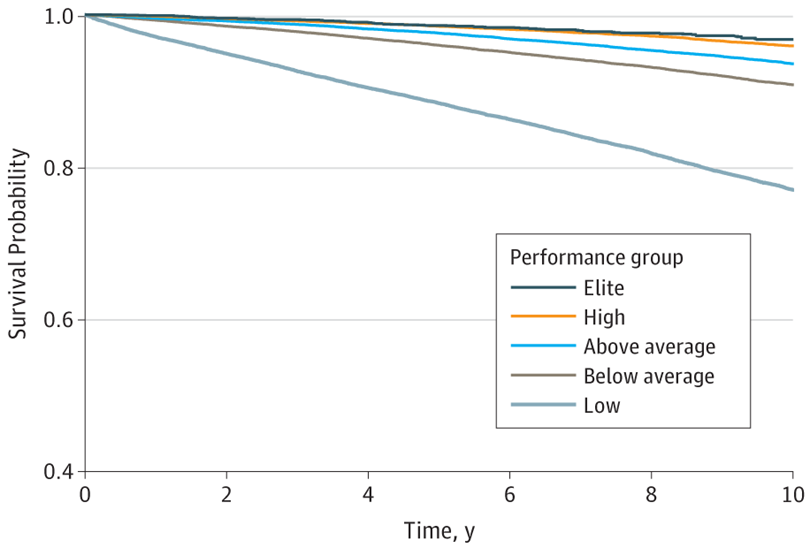
The Takeaway: There is no "upper limit" where being fitter stops being good for you. But the biggest return on investment comes from moving from "Low" to "Below Average." Just getting off the couch saves your life.
To build an engine that lasts, you cannot train at the same intensity every day. You need to structure your training like a triangle (or a pyramid).
You need a wide base to support a high peak.
"Zone 2" has become a buzzword in longevity circles, but what does it actually mean?
Physiologically, Zone 2 is the highest intensity at which you can still produce energy primarily using fat and oxygen in your mitochondria, while keeping lactate levels low (below 2 mmol/L).
Why is this the "Base"? Aging is essentially a crisis of energy. As we age, our mitochondria (the power plants of our cells) become dysfunctional. They become inefficient at burning fat and produce more "exhaust" (oxidative stress).
Zone 2 training is the specific signal that tells the body to:
If you skip this base and only do high-intensity classes (like spinning or CrossFit), you build a "house of cards", a high peak with no foundation. You might be fast, but your cellular machinery remains inefficient.
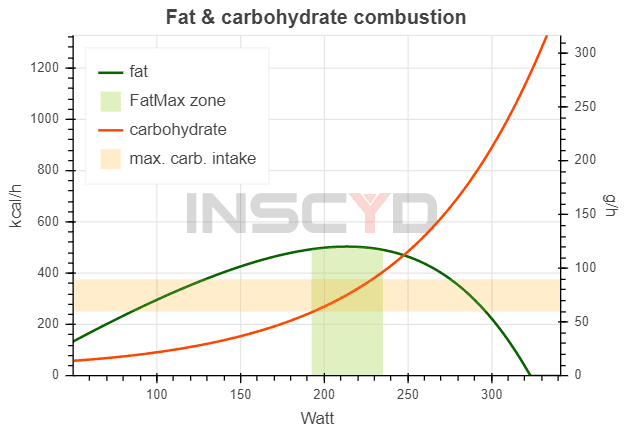
The Practical Test: How do you know you are in Zone 2? The Talk Test. You should be able to maintain a conversation, but it should feel slightly strained. If you can sing, go harder. If you have to gasp between sentences, slow down.
If Zone 2 is about efficiency, VO2 Max is about Capacity.
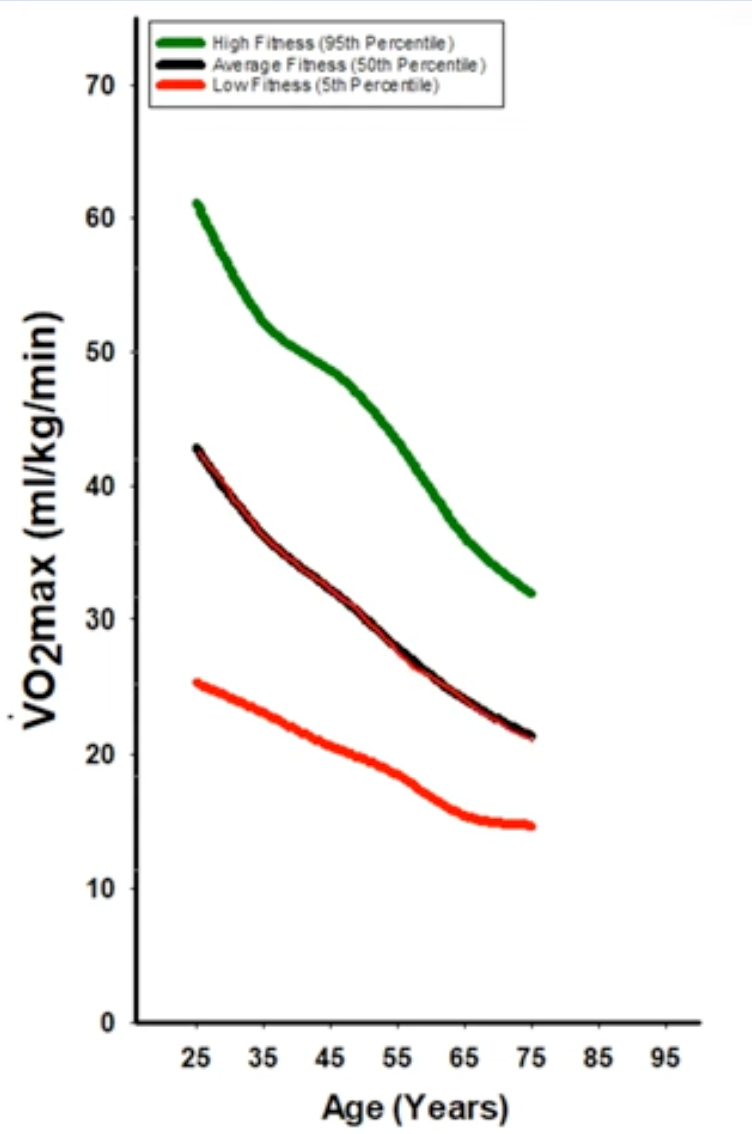
Why do you need a high capacity if you don't plan on racing? Because of the slope of decline.
VO2 Max declines by roughly 10% per decade after age 30. If you start with a VO2 Max of 35 (average) at age 40, you will likely hit the "frailty threshold" (a VO2 Max of roughly 18, required for independent living) by your late 70s.
However, if you train to raise your VO2 Max to 50 (Elite) at age 40, you create a massive buffer. Even with the natural decline, you will cross into your 90s with enough capacity to hike, travel, and play.
How do you program this? This is where the Time-Constraint Trade-Off comes in.
The "gold standard" for endurance athletes is Polarized Training: 80% of time in Zone 2, 20% of time at high intensity. But this assumes you have 6-10 hours a week to train.
What if you are a busy parent with 3 hours a week?
If you have low time availability, you do not have the luxury of building a massive aerobic base. You must leverage intensity to compensate for volume.
As mentioned in our main guide, there is a specific nuance for women when it comes to cardio, particularly high-intensity work.
Because of the hormonal fluctuations in cortisol and progesterone, women are often more sensitive to the stress of fasting combined with high-intensity exercise. Doing HIIT intervals on an empty stomach can trigger a catabolic (breakdown) state that hinders adaptation.
The Fix: If you are doing your hard intervals (The Peak), ensure you have some circulating amino acids. A small protein serving (15-30g) before training can make the difference between breaking your body down and building it up.
You are building an engine for the long haul.
Every Zone 2 session cleans up your metabolism for today. Every HIIT session raises your ceiling for tomorrow. The goal is to arrive at the last decades of your life with an engine that is still powerful enough to take you wherever you want to go.
Disclaimer: This information is for educational purposes only and is not intended to diagnose, treat, or prevent any medical condition. Consult with a doctor before making any changes especially if you have existing health conditions or concerns.
Citations:
Attia, P. (Host). (2023, July 10). Training for The Centenarian Decathlon: zone 2, VO2 max, stability, and strength [Audio podcast episode]. In The Peter Attia Drive. Episode #261. https://peterattiamd.com/training-for-the-centenarian-decathlon/
Gifford et al. (2016). The physiological reserve to do daily activities.
INSCYD. (2018). FatMax Whitepaper. Retrieved from http://inscyd.com/whitepaper/fatmax2018/
Mandsager et al. (2018): Association of Cardiorespiratory Fitness with Long-term Mortality Among Adults Undergoing Exercise Treadmill Testing. Published in JAMA Network Open.
Wisløff, U. et al (2007) Superior cardiovascular effect of aerobic interval training versus moderate continuous training in heart failure patients: a randomized study. Published in: PubMed
Patrick, R. (n.d.). How to Train: A Guide on Getting Strong, Building Muscle, and Elevating Fitness According to the Experts.

 EN
EN
 DE
DE

